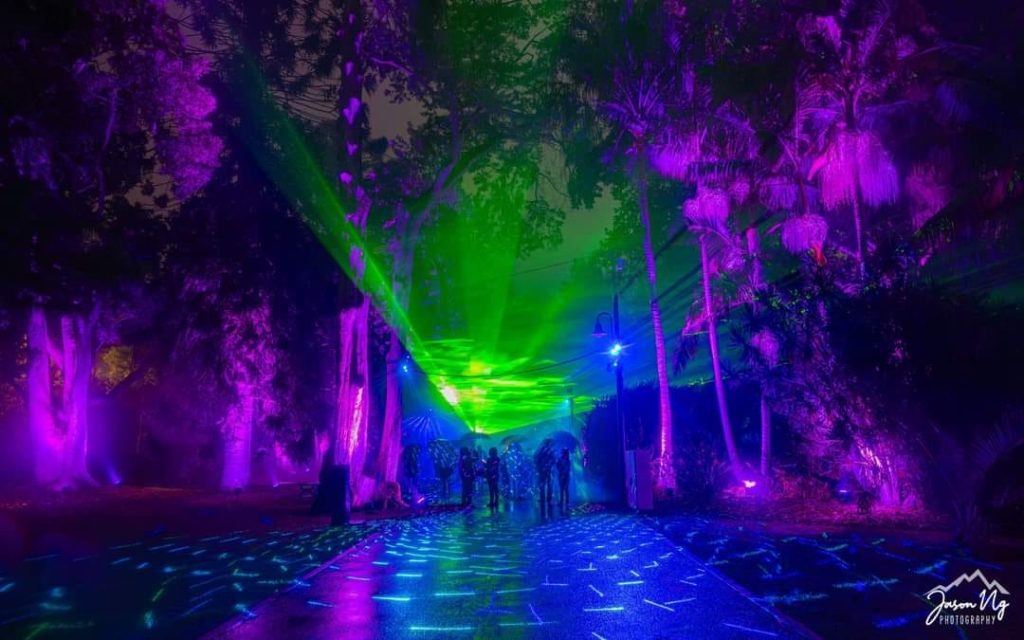
Sky glow from the proposed Mt Coot-tha light shows would be visible across Brisbane, producing as much light as up to seven tennis stadiums operating a night.
The Brisbane Astronomical Society said in its submission to council that the total light flux created by lighting fixtures across the proposed Night Walks at Mt Coot-tha could be around 2,248,000 lumens.
“This is a lighting equivalent of approximately 5.6 to 7.5 centre-court professional tennis stadiums in simultaneous operation, for 150 nights each year, within the Mt Coot-tha Botanical Gardens,” the submission stated.
“The claim that the environmental impact of an artificial lighting display can be adequately assessed when the proposed lighting display has not yet been designed and sighted by the assessing consultant, is preposterous.
“The actual disruption to a nocturnal species would appear to be quite significant, being about one-third of the night hours available.”
In August 2022 ABC News, Deputy Krista Adams stated tourists spending one more night in Brisbane would inject billions into the annual economy.
Cr Adams is also quoted as saying there would be minimal effect on any fauna despite Council being informed at the pre-lodgement meeting in March 2022 that there would be no design detail provided until after council approved the development application.
Mt Coot-tha Protection Alliance (MCPA) representative Bronwyn Raftery said that the lighting report, submitted as part of Light Dreaming’s development application, failed to make any reference to the National Light Pollution Guidelines for Wildlife.
Ms Raftery noted that Brisbane City Council has also chosen to ignore The National Light Pollution Guidelines for Wildlife despite the documentation of high UV output used in light shows causing disturbance to insects and nocturnal animals.
An article published in Nature (2017) lists light pollution as a new threat to successful pollination of both crops and wild plants.
Flying-foxes are Australia’s only nocturnal, long distance, efficient pollinators. The cross-pollination service they perform is essential for Eucalypt species according to Wildlife Information, Rescue and Education Service (WIRES).
Denise Wade, Senior Trauma Carer Bat Conservation and Rescue Qld said “elevated cables, nets, wires and flashing lights can pose lethal threats to bats including, but not limited to, entanglement.
“Unlike microbats that echolocate, flying-foxes rely heavily on sight and flashing lights will cause extreme distress and disorientation.
“Injured bats have the potential to pose a public health risk and will require rescue from volunteers who may not have the equipment required to perform rescues in an installation of this magnitude.”
Mt Coot-tha Protection Alliance Inc spokesperson Bronwyn Raftery said “although they won’t disclose the plan to residents, Brisbane City Council says they are committed to drawing thousands of visitors to the Mt Coot-tha Botanic Gardens at night for a world-class experience.
“Similar to Victoria Park, it is important to remember that public greenspace preservation leaves a lasting legacy for future generations.”
MCPA Banner Crew Event Mt Coot-tha Botanic Gardens entrance this Saturday, 4 May from 10 to 11am
Attached
Brisbane Astronomical Society Submission
Pre-Lodgement Meeting Minutes
About MCPA
National Light Pollution Guidelines for Wildlife – DCCEEW
View
Stadium Lights
https://www.mecreeled.com/football-stadium-lights-turning-many-lumens-need-light-football-field/
Media – Deputy, Cr Krista Adams
Wildlife Information, Rescue and Education Service (WIRES)
https://www.wires.org.au/wildlife-programs/jaliigirr-biodiversity-alliance
Brisbane City Council iDevelopment (Lumina Night Walks DA 006083027)
Development Application A006083027